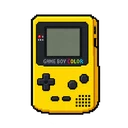
Game Boy Color
Nintendo's Game Boy and its colour successor
- 1998Released
- HandheldType
- NintendoDeveloper

GBC Specifications
- Processor
- Sharp Corporation LR35902
- Processor Speed
- 4 MHz or 8 MHz (Two modes)
- RAM
- 32 KB
- Video RAM
- 16 KB
- Resolution
- 160 x 144 pixels
- Colors Available
- 32,768 (15-bit)
- Max Colors on Screen
- 10, 32, or 46
- Max Sprites
- 40
- Max Sprites per Scan Line
- 10 (4 colors maximum per sprite)
- Max Sprite Size
- 8 x 8 or 8 x 16 pixels
Overview
The Game Boy Color, often abbreviated to GBC, is the successor to Nintendo’s Game Boy. Its hardware differed little from the original Game Boy, but it added one major feature: a colour screen instead of the Game Boy’s greyscale display. Because the hardware was so similar, the Game Boy Color stayed backwards compatible with older Game Boy games.
This backwards compatibility was a big advantage over its competitors, as the handheld inherited a large library from day one rather than relying on a few new games to drive sales.
The Game Boy Color was a huge success. Together with the original Game Boy, it sold 118.69 million units, far more than competitors of the time such as the Neo Geo Pocket Color and WonderSwan.
Key Features
Colour Screen
Replaced the Game Boy's greyscale display with colour.
Backwards Compatible
Plays older Game Boy games, a large library from day one.
Dual Speed Modes
The Sharp LR35902 runs at either 4 MHz or 8 MHz.
Huge Success
With the Game Boy, outsold the Neo Geo Pocket Color and WonderSwan.
Advertisement






Which one to pick
Known forVery high accuracy for the Game Boy, Game Boy Color and Super Game Boy, with a powerful debugger.
Known forFast and accurate, and plays Game Boy Advance games too.
Known forAccurate emulation with a debugger popular with homebrew developers, and link play over a network.
Known forPortable open source emulation with accurate CPU timing, also used as a RetroArch core.
Known forAccuracy tested against the gbdev test ROMs, with some of the best tools for homebrew developers.
Known forAccurate emulation based on testing hardware corner cases. Its core lives on in RetroArch and OpenEmu.



In short
SameBoy is the most accurate choice and also handles the Super Game Boy. mGBA is a good all-rounder that covers the Game Boy Advance as well. BGB and Emulicious suit developers and players who want link play or debugging tools, and Gearboy is a portable, open source option. Gambatte is no longer updated as a standalone emulator but remains a popular core. The many older Game Boy Color emulators here are kept as an archive.