Atari
The company that brought games home
- 7Systems
- 1977–1993Released
- 27Emulators
Home Consoles 4


Handhelds 1

Computers and Platforms 2


Advertisement
Atari was founded in 1972 by Nolan Bushnell and Ted Dabney. Its name comes from the board game Go, where it warns that a stone is about to be captured. Its first hit, Pong, helped start the arcade industry, and the Atari 2600 did the same for games at home.
Atari took heavy losses in the 1983 crash, and in 1984 its owner, Warner Communications, split it up: the arcade business became Atari Games, and the home business was sold to Jack Tramiel, the founder of Commodore, as Atari Corporation. After a merger with JTS in 1996, the name passed to Hasbro in 1998 and then to Infogrames, whose successor, Atari SA, still uses it.
 Atari 2600
Emulators and more
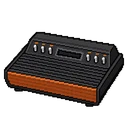
The Atari 2600 came out in 1977 as the Atari Video Computer System and was renamed in 1982. It made cartridge consoles popular, sold around 30 million units and stayed on sale until 1992. Its library includes Adventure, Pitfall!, Space Invaders and Pac-Man. Stella emulates it almost perfectly.
 Atari 8-bit Computers
Emulators and more
The Atari 400 and 800, from 1979, were home computers with custom graphics and sound chips designed by the team behind the 2600. The family continued with the XL and XE models until 1992, and its games include Star Raiders and M.U.L.E.
 Atari 5200
Emulators and more
The Atari 5200, from 1982, was built from the 8-bit computers’ hardware as a successor to the 2600. Its analogue joysticks broke easily and it could not play 2600 games at launch, and it was dropped in 1984.
 Atari ST
Emulators and more
The Atari ST, from 1985, was Jack Tramiel’s answer to the Macintosh and the Amiga, sold at a much lower price. It was popular in Europe for games, and its built-in MIDI ports made it a standard in music studios for years.
 Atari 7800
Emulators and more
The Atari 7800 was ready in 1984 but held back by the company split, and it only came out in 1986. It played 2600 games, but by then the NES dominated, and it had a small library.
 Atari Lynx
Emulators and more
The Lynx, from 1989, was the first handheld with a colour screen, and it could scale and rotate sprites in hardware. It was big, expensive and hard on batteries, and sold far fewer than the Game Boy.
 Atari Jaguar
Emulators and more
The Jaguar, from 1993, was Atari’s last console, advertised as the first 64-bit system. Hard to program for and short of games, it sold poorly, though Alien vs Predator and Tempest 2000 are still remembered. Its failure ended Atari as a hardware maker.


