Xbox
Microsoft's first console, the home of Halo
- 2001Released
- 6thGeneration
- MicrosoftDeveloper

Xbox Specifications
- Processor
- Custom Intel Pentium III Coppermine-based processor (32-bit)
- Processor Speed
- 733 MHz
- Processor L1 Cache
- 64KB
- Processor L2 Cache
- 128KB
- RAM
- 64 MB DDR SDRAM (Shared)
- GPU
- NV2A ASIC (Co-Developed by Microsoft and Nvidia)
- GPU Speed
- 233 MHz
- Audio Processor
- NVIDIA 'MCPX' (a.k.a SoundStorm 'NVAPU')
- Audio Channels
- 64 3D (256 Stereo)
Overview
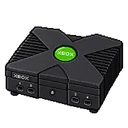
The Xbox was Microsoft’s first real venture into console development. Microsoft had been involved in PC gaming for many years, but had never built a console before. The Xbox belonged to the sixth generation of consoles, competing with the Nintendo GameCube, the SEGA Dreamcast and the Sony PlayStation 2.
Unlike its rivals, which used highly customised hardware, the Xbox was built much like a PC, an architecture Microsoft knew well. It also included a built-in hard drive for saving games, removing the need to buy memory cards.
Xbox emulation was slow to progress. For years, emulators such as CXBX, DXBX and Xeon could only get a handful of games in-game, and performance was poor. Despite the console’s resemblance to a PC, its custom hardware and the lack of documentation made it hard to emulate. Today xemu, which grew out of the XQEMU project, is the leading Xbox emulator and can run a large part of the library.
The Xbox also had a built-in Ethernet port, and with Xbox Live it was the first console to build a proper online gaming community. As well as online play, Xbox Live offered a friends list and ways to interact with other players. Its reliable service, together with the online play of Halo 2, helped make it a success.
The Xbox did well for a first console. It finished a distant second to the PlayStation 2 with over 24 million units sold, ahead of Nintendo’s GameCube and well ahead of the SEGA Dreamcast.
Key Features
PC Architecture
Built much like a PC, an architecture Microsoft knew well.
Built-In Hard Drive
Saved games to an internal drive, with no memory cards needed.
Xbox Live
Online play, a friends list and a real online community.
3D Audio
NVIDIA SoundStorm audio with 64 3D channels.
Advertisement
Xbox Emulators




Which one to pick
Known forLow-level emulation based on QEMU with good compatibility, render scaling above 480p, save states and network play with other copies and real consoles.
Known forContinues Cxbx with high-level kernel emulation and low-level NV2A graphics, plus optional network emulation and USB pass-through for Xbox controllers.
Known forConverts Xbox executables into Windows programs instead of emulating the hardware. Most games fail, and it may not run on 64-bit Windows.
Known forAn emulator written in Delphi that ran a range of demos and showed a few games close to playable before its two developers stopped.
Known forThe first emulator to get a commercial Xbox game in-game, Halo: Combat Evolved, though never at a playable speed.
In short
xemu is the one to use: it is actively developed, has builds for Windows, macOS and Linux, and is the most compatible Xbox emulator, with render scaling and network play. It needs system files dumped from an Xbox. Cxbx-Reloaded is an open source alternative for 64-bit Windows that publishes only pre-release builds. The original CXBX, DXBX and Xeon stopped long ago and are kept here as an archive.