PlayStation
Sony's first console, built on CD-ROM
- 1994Released
- 5thGeneration
- SonyDeveloper

PlayStation Specifications
- Processor
- LSI Logic Corp LR333x0-based Core
- Processor Speed
- 33.8688 MHz
- RAM
- 88 MB
- Video RAM
- 1 MB
- Colors Available
- 16.7 million (24-bit)
- Resolution
- 256 x 225 to 640 x 480 pixels
Overview
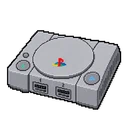
The PlayStation, also known as the PS, PS1 and PSX, was Sony’s first console. Released in 1994 in Japan and 1995 in North America and Europe, it became the best-selling console of the fifth generation and the first console to sell over 100 million units. It turned Sony into one of the most formidable companies in gaming.
The PlayStation’s main competitors were the Nintendo 64 and the SEGA Saturn. Despite facing established giants Nintendo and SEGA, the PlayStation outsold the Nintendo 64 and left the Saturn a distant third. One of its biggest advantages was its use of CDs. Cartridges loaded faster and were more durable, but they could not match the storage space of a CD. CDs were also much cheaper to produce, which appealed to publishers because making large quantities of a game carried far less risk.
PlayStation emulation is very mature, with the vast majority of games running without major issues. Emulator developers now focus mostly on accuracy, speed and enhancements such as rendering games at higher internal resolutions. Many long-standing PS1 emulators, such as ePSXe and PCSX-Reloaded, are plugin-based; DuckStation is a popular, actively developed alternative that works without plugins.
Key Features
CD Games
CDs held far more than cartridges and cost much less to make.
100 Million Sold
The first console to sell over 100 million units.
24-Bit Colour
Displays up to 16.7 million colours at up to 640 x 480.
Sony's First Console
Sony's first console, which made it a formidable gaming company.
Advertisement
PlayStation Emulators




Which one to pick
Known forAccuracy with good speed on low-end hardware, plus upscaling, PGXP for stable polygons, rewind, runahead and RetroAchievements. Needs a BIOS from your own console.
Known forOne of the most popular PS1 emulators, running the vast majority of games, with a plugin system and an HLE BIOS for some games.
Known forA command-line multi-system emulator whose PlayStation emulation is known for its accuracy, with rewind, netplay and video recording.
Known forWorks out of the box with no plugins, virtual drive or BIOS file, using its own free BIOS clone. Some games may be less compatible with the clone.
Known forA plugin-free emulator with a built-in R3000 debugger. Its compatibility is decent but behind ePSXe and PCSX-Reloaded.
Known forThe open source continuation of PCSX, with compatibility roughly on par with ePSXe and the same plugins. Its code lives on in forks such as PCSX-ReARMed.
Known forA fast commercial emulator written mostly in assembly. Its court wins against Sony helped establish that emulators are legal.
In short
DuckStation is the one most people should start with: it aims for accuracy while running well on low-end hardware, with upscaling, PGXP and RetroAchievements, and has builds for Windows, macOS, Linux and Android. ePSXe is a long-running, plugin-based alternative with high compatibility, though only its Windows version is still updated. Mednafen suits players who want accuracy and don’t mind a command line. no$psx works out of the box with no plugins or BIOS file, and pSX is worth trying when a game has problems elsewhere. PCSX-Reloaded and Bleem! are no longer developed and are kept here as an archive.