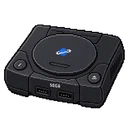
SEGA Saturn
SEGA's dual-CPU 32-bit console
- 1994Released
- 5thGeneration
- SegaDeveloper

Sega Saturn Specifications
- CPU
- Two Hitachi SuperH2 7604 RISC (32-bit)
- CPU Speed
- 28.6 MHZ
- RAM
- 1 MB (8 Megabits) SDRAM | 1 MB (8 Megabits) DRAM
- GPU
- VDP1 (32-bit) Video Display Processor
- VDP1 Video RAM
- 512K (4 Megabits)
- VDP1 Framebuffer RAM
- 256k x 2 (2x2 Megabits)
- GPU Co-Processor
- VDP2 (32-bit) background and scroll plane video display processor
- VDP2 Video RAM
- 512K (4 Megabits)
- VDP2 Color RAM
- 4K
- Resolutions
- 352 x 240 pixels | 640 x 240 pixels | 704 x 480 pixels
Overview
The Sega Saturn is a fifth-generation console developed and sold by Sega. It was released on 22 November 1994 in Japan, 11 May 1995 in North America and 8 July 1995 in Europe. It is the successor to the Sega Genesis.
The North American launch was a surprise that caught many retailers off guard, as only a few had been told about it. As a result, some retailers refused to stock Sega’s products. The Saturn used a dual-CPU design with eight processors in total, and its games came on CD-ROM.
Much of the Saturn’s library consists of arcade ports, including Daytona USA, Last Bronx and Die Hard Arcade. By 1998 it had more games than its rival, the Nintendo 64. The Saturn sold well in Japan but struggled in North America: it launched there four months before the PlayStation, but sales were shaky, and the arrival of the Nintendo 64 in 1996 made matters worse. Sega discontinued the Saturn in 1998, after it had sold only about 9.5 million units worldwide, and it is considered a commercial failure.
The Saturn’s failure, during a decline in the industry, put Sega under heavy financial strain and led to departures within the company. When the system was discontinued, the Western market went without new Sega games for over a year.
Key Features
Dual-CPU Design
Two Hitachi SH-2 CPUs among eight processors in total.
CD-ROM Games
Its games came on CD-ROM discs.
Arcade Ports
Much of its library consists of arcade ports like Daytona USA.
Twin Video Chips
VDP1 plus a second VDP2 chip for background and scroll planes.
Advertisement
SEGA Saturn Emulators







Which one to pick
Known forA newer open source emulator with save states, rewind, many disc formats and a debugger, on x86-64 and ARM. Needs a Saturn BIOS.
Known forA command-line multi-system emulator whose Saturn emulation is known for its accuracy. Needs the Saturn BIOS and a 64-bit build.
Known forOne of the most compatible Saturn emulators, running the vast majority of games. It emulates the BIOS itself, so no BIOS file is needed.
Known forA Yabause-based emulator built for Android first, with higher-resolution rendering, cheats and cloud save sync between Android and Windows.
Known forA fork of Yabause that most people use as a RetroArch core. Its releases provide standalone builds for Ubuntu Linux only.
Known forAn open source, cross-platform emulator with renderers that output at higher resolutions. Its code lives on in YabaSanshiro and Kronos.
Known forOne of the first emulators to run commercial Saturn games, later overtaken by SSF.
In short
Ymir is the actively developed standalone choice on Windows, macOS and Linux, though it still calls itself a work in progress. Mednafen offers accurate Saturn emulation from the command line, and on Windows SSF runs the vast majority of Saturn games with no BIOS file needed. YabaSanshiro is the option for Android and iOS, and Kronos is mostly used as a RetroArch core. The original Yabause is no longer actively developed and Satourne has ended; both are kept here as an archive.