Nintendo DS
Nintendo's dual-screen touch handheld
- 2004Released
- 7thGeneration
- NintendoDeveloper
Nintendo DS Specifications
- Processor (Original)
- ARM946E-S (Gameplay mechanisms and video rendering)
- Processor Speed (Original)
- 67 MHz
- Processor (DSi)
- ARM9
- Processor Speed (DSi)
- 133 MHz
- Co-Processor
- ARM7TDMI (Sound output, Wi-Fi and GBA mode)
- Processor Speed (DSi)
- 33 MHz
- Memory (Original)
- 4MB SRAM
- Memory (DSi)
- 16 MB PSRAM
- Video RAM
- 3MB (2MB Z-Buffer + 1 MB texture cache)
- Resolution
- 256 x 192 Pixel (Both Screens)
- Wireless
- Built-in 8021.11 b/g (WEP Encryption Only)
Overview
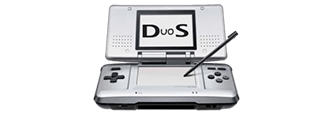
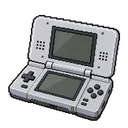
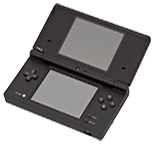
The Nintendo DS was Nintendo’s successor to the Game Boy Advance. It kept a clamshell design like the Game Boy Advance SP but used it very differently, and introduced several features that were new to handhelds.
The most obvious is its two screens, which work together, with the lower one doubling as a touchscreen so players can interact directly with what is shown. At the time this was a big departure from the standard single screen and buttons.
The DS also has a built-in microphone, which games used for ideas such as blowing on the screen to clear away smoke. Its Wi-Fi let it connect to other DS systems and play online through the Nintendo Wi-Fi Connection service. That service shut down in 2014, ending online play for all DS games; players who want online features have to turn to the 3DS.
The DS was followed by several revised models. The first was the Nintendo DS Lite, which kept all the features of the original but was much slimmer and had better screens. Its internal changes were mostly about saving battery rather than improving performance, and it kept the original’s ability to play Game Boy Advance games.
After the DS Lite came the DSi, which added cameras, improved Wi-Fi and better screens, and was also sold as the larger-screen DSi XL. Its hardware was more powerful, and a few games were made specifically for it, but most developers made sure their games worked on every model rather than using the improvements. The DSi also dropped support for Game Boy Advance games.
Key Features
Dual Screens
Two screens that work together in a clamshell design.
Touchscreen
The lower screen doubles as a touchscreen.
Built-In Microphone
Games used it for ideas like blowing smoke off the screen.
Wi-Fi Play
Built-in Wi-Fi for local play and online play until 2014.