PlayStation 3
Sony's Cell-powered HD console
- 2006Released
- 7thGeneration
- SonyDeveloper
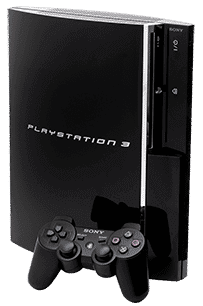
PS3 Specifications
- Processor
- Cell Microprocessor
- Processor Speed
- 3.2 GHz
- Processor Cores
- 9
- Co-Processor
- Emotion Engine (1st Gen only, Used for PS2 Emulation)
- Co-Processor Speed
- 294.912 MHz
- RAM
- 256 Mb XDR DRAM
- GPU
- RSX 'Reality Synthesizer'
- GPU Speed
- 550 MHz
- GPU Co-Processor
- 'Graphics Synthesizer' (1st and 2nd gen only, used for PS2 Emulation)
- GPU Co-Processor Speed
- 147.456 MHz
- Video RAM
- 256 MB GDDR3
- Resolution
- Up to 1080p output
Overview
The PlayStation 3 is the successor to the PlayStation 2. It competed with Microsoft’s Xbox 360 and Nintendo’s Wii in a hard-fought battle that lasted to the end of the seventh generation of consoles.
The PS3 got off to a slow start, launching a year after the Xbox 360 and at a much higher price. That pushed Sony to back the console hard, and it became home to some of the most acclaimed games of all time, including Metal Gear Solid 4, the Uncharted series and The Last of Us.
Its late launch was not the only problem. Although the PS3 was more powerful than its competitors on paper, it was very hard to program for because of its powerful but complex Cell processor. This made development difficult, especially early in the generation, before studios had worked out how to get the best out of it.
The Cell processor is also what makes the PS3 so hard to emulate, and many people thought PS3 emulation would never be possible. RPCS3, started in 2011 by DH and Hykem, proved otherwise. After years of development it can now play the majority of the PS3 library, many games at higher resolutions and frame rates than the original console.
Key Features
Cell Processor
A powerful but complex Cell processor that was hard to program.
HD Output
Outputs games in high definition at up to 1080p.
PS2 Compatibility
Early models included PS2 chips for backwards compatibility.
Acclaimed Games
Home to Uncharted, Metal Gear Solid 4 and The Last of Us.