
PlayStation 5
Sony's current console
- 2020Released
- 9thGeneration
- SonyDeveloper
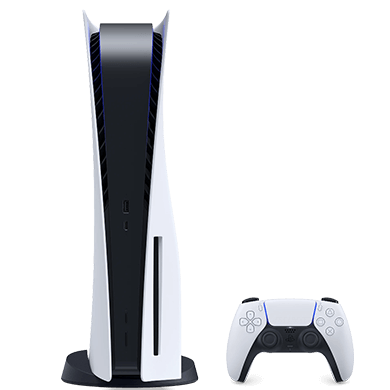
PS5 Specifications
- CPU
- x86-64-AMD Ryzen Zen
- CPU Cores
- 8 Cores / 16 Threads
- CPU Speed
- 3.5 GHz (Variable)
- GPU
- AMD Radeon RDNA 2-based
- GPU Speed
- 2.23GHz (Variable)
- GPU Cores
- 36 RDNA2 Compute Units
- RAM
- 16 GB GDDR6
- Audio
- 'Tempest' 3D AudioTech
- Internal Storage
- 825 GB NVMe
Overview
The PlayStation 5 is Sony’s ninth-generation console and the successor to the hugely popular PlayStation 4.
Its technical improvements represent one of the biggest leaps in console performance.
Sony built the PlayStation 5 around AMD’s Zen 2 CPU and RDNA 2 GPU architectures, both of which were cutting-edge when the console was released in 2020.
Sony’s most significant change was the new DualSense controller. On the outside it has a more refined shape and better button placement.
Inside, new haptic feedback technology gives the rumble far more fidelity.
The triggers have also been redesigned to provide adjustable resistance. Games can change how the triggers respond depending on the action: when drawing a bow, for example, you can feel the tension increase as you pull the trigger.
Of all the changes in the new hardware, the controller does the most to set the console apart from previous generations.
PS5 emulation is at an early stage. The open source KytyPS5, for Windows and Linux with experimental macOS support, can boot 2D games and a selection of 3D games, but compatibility is limited.
Be careful with other programs that claim to be PS5 emulators. Many are fake and bundled with adware or malware, especially those that promise to run any PS5 game.
Key Features
DualSense Controller
A more refined shape with better button placement.
Haptic Feedback
New haptic technology gives the rumble far more fidelity.
Adaptive Triggers
Triggers with adjustable resistance, like feeling a bow's tension.
Tempest 3D Audio
Sony's custom Tempest 3D AudioTech handles the console's audio.