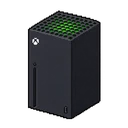
Xbox Series X/S
Microsoft's current pair of consoles
- 2020Released
- 9thGeneration
- MicrosoftDeveloper

Xbox Series X/S Specifications
- CPU
- Custom AMD 8-core Zen 2
- CPU Cores
- 8
- CPU Speed
- 3.8 GHz, 3.6 GHz with SMT (Series X) | 3.6 GHz, 3.4 GHz with SMT (Series S)
- GPU
- Custom AMD Radeon RDNA 2
- GPU Speed
- 52 CUs @ 1.825 GHz (Series X) | 20 CUs @ 1.565 GHz (Series S)
- RAM
- 16 GB GDDR6 SDRAM (Series X) | 10 GB GDDR6 SDRAM (Series S)
- Storage
- 1 TB NVMe SSD (Series X) | 512 GB NVMe SSD (Series S)
- Audio
- Custom Project Acoustics 3D Audio
Overview
The Xbox Series X and Series S are Microsoft’s ninth-generation consoles, released at the end of 2020. They succeed the Xbox One and are Microsoft’s fourth generation of Xbox hardware.
Like the PlayStation 5, the Xbox Series consoles use AMD’s Zen 2 CPU architecture and RDNA 2 GPU architecture.
At launch, this gave them performance comparable to a fairly high-end gaming PC, at a fraction of the cost of building a PC with similar capabilities.
Microsoft’s marketing focused heavily on backward compatibility. The Series consoles can play almost all Xbox One games, along with a large number of Xbox 360 and original Xbox games.
The biggest hardware change was storage speed. Consoles had relied on slow hard drives for years, but the Xbox Series consoles use NVMe solid-state drives, which load data far faster.
This made features such as Quick Resume possible, which saves the state of several games to the drive so players can switch back to them in seconds.
There is no working Xbox Series emulator, so be wary of any website that claims to offer one.
Key Features
Modern AMD Chips
Custom AMD Zen 2 CPU and RDNA 2 GPU architectures.
NVMe Storage
Solid-state drives load data far faster than old hard drives.
Quick Resume
Switches back to several suspended games in seconds.
Backward Compatible
Plays nearly all Xbox One games and many older Xbox games.