SEGA Pico
SEGA's educational console for young children
- 1993Released
- Home ConsoleType
- SEGADeveloper
SEGA Pico Specifications
- Processor
- Motorola 68000 (16-bit)
- Processor Speed
- 7.6 MHz
- RAM
- 64 KB
- GPU
- Genesis video processor (Yamaha YM7101)
- Resolution
- 320 x 224 pixels
- Media
- Storyware book cartridges
Overview
The SEGA Pico is an educational console for children aged about three to seven. It was released in Japan as the Kids Computer Pico in June 1993, and in North America and Europe in 1994.
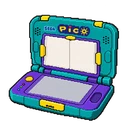
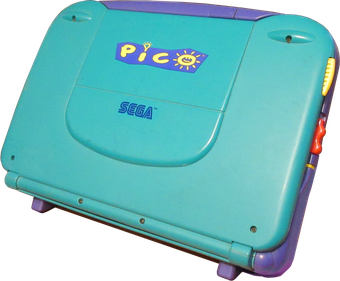
The Pico is built on the same technology as the SEGA Genesis, with a 68000 processor and the Genesis video chip, but it looks nothing like a normal console. It folds open like a laptop, and its games, called Storyware, are cartridges shaped like picture books. Turning a page of the book changes the scene on the television, and children play by touching a stylus, the Magic Pen, on the pages or on a drawing pad.
Games taught reading, counting, music and drawing, often with licensed characters such as Sonic the Hedgehog, Mickey Mouse and Winnie the Pooh. The Pico was far more successful in Japan than in the West, where it was discontinued in 1998. In Japan it was sold until 2005 and followed by the Advanced Pico Beena.
SEGA reports sales of 3.4 million Pico consoles and 11.2 million Storyware cartridges.
Emulating the Pico means showing the book pages beside the game and using the mouse as the Magic Pen. PicoDrive, which is named after the system, has the most complete support, including scanned Storyware pages. Kega Fusion and MAME can also run Pico games.
Key Features
Storyware Books
Cartridges shaped like picture books that change the scene.
Magic Pen
Children play by touching a stylus on pages or a drawing pad.
Educational Games
Taught reading, counting, music and drawing to young children.
Genesis Inside
Built on Genesis technology in a fold-open, laptop-like case.