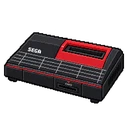
SEGA Master System
SEGA's 8-bit console
- 1985Released
- 3rdGeneration
- SegaDeveloper

Master System Specifications
- Processor
- Zilog Z80A
- Processor Speed
- 3.55 MHz (Pal/SECAM) | 3.58 (NTSC)
- RAM
- 64 Kbits (8 KB)
- GPU
- Video Display Processor (VDP) derived from Texas Instruments TMS9918
- Video RAM
- 128 Kbits (16KB)
- Resolution
- 256 x 192 and 256 x 224 Pixels
Overview
The Sega Master System is a third-generation console developed and manufactured by Sega. It was first released in Japan in 1985 as the Sega Mark III, and was redesigned as the Master System for its North American launch in 1986.
Both versions could play cartridges as well as credit card sized Sega Cards. The cards were cheaper than cartridges but held much less data, only 256 kilobits, and were eventually dropped because of this limit.
The Master System’s hardware was more powerful than the NES, with twice as much memory and a faster CPU, but this was not enough to overcome the NES and Nintendo’s strong franchises. Accessories included 3D glasses and a light gun, both designed for specially made games.
Facing strong competition from Nintendo, the Master System sold only about 10 to 13 million units in its lifetime, far fewer than the NES, which sold over 62 million. Its game library was criticised as too small. Sega’s mascot at the time, Alex Kidd, starred in several of its games, and later releases included Street Fighter II and Dynamite Headdy.
Key Features
Sega Cards
Played cartridges and cheaper credit card sized Sega Cards.
Beyond the NES
Twice the memory of the NES and a faster CPU.
3D Accessories
3D glasses and a light gun worked with specially made games.
Sega's Mascot
Sega's mascot Alex Kidd starred in several of its games.
Advertisement
Sega Master System Emulators











Which one to pick
Known forAn accurate Z80 core that covers undocumented behaviour, accurate VDP timing, and Game Gear and SG-1000 support.
Known forTested accuracy and strong tools for homebrew developers, including a debugger with reverse stepping. Needs Java.
Known forAccurate Sega 8-bit and 16-bit emulation, used mostly as a RetroArch core and built into BizHawk and OpenEmu.
Known forA fast Sega emulator first made for ARM handhelds. On desktops and Android most people use its RetroArch core.
Known forA multi-system emulator with a built-in debugger and tools for homebrew development and ROM hacking.
Known forA multi-system emulator that puts accuracy first and runs slower than speed-focused emulators.
Known forAn NES emulator with cycle-accurate timing that added Master System support in version 4.0.
Known forLong regarded as one of the best all-in-one Sega emulators, with a focus on accuracy, netplay and scaling filters.
In short
For Master System games on Windows, macOS or Linux, Gearsystem is accurate and actively developed, and Emulicious adds strong debugging tools for homebrew work. Genesis Plus GX and PicoDrive are mostly used as RetroArch cores. Mesen, ares and Nemulator cover the Master System alongside other consoles. Kega Fusion is no longer developed and is kept here as an archive.