WonderSwan / Color
Bandai's handheld from the Game Boy's designer
- 1999Released
- HandheldType
- BandaiDeveloper
WonderSwan / Color Specifications
- Processor
- NEC V30 MZ (16-bit)
- Processor Speed
- 3.072 MHz
- RAM
- 16 KB (WonderSwan) | 64 KB (WonderSwan Color)
- Display
- Monochrome LCD (WonderSwan) | 241 colours from 4,096 (WonderSwan Color)
- Resolution
- 224 x 144 pixels
- Media
- ROM cartridge
Overview
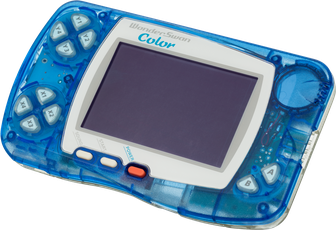
The WonderSwan is a handheld console made by Bandai and released in Japan in March 1999. It was designed by Koto, the company founded by Gunpei Yokoi after he left Nintendo, where he had created the Game & Watch and the Game Boy.
It was cheap, ran for around 30 hours on a single AA battery and could be held both horizontally and vertically, with games designed for either way. The WonderSwan Color followed in December 2000, and the SwanCrystal, with a better screen, in 2002.
Bandai won strong support from Square, who released remakes of the first Final Fantasy games for the WonderSwan Color, and it had plenty of anime licences such as Digimon, Gundam and One Piece. At its peak it took a notable share of the Japanese handheld market, but the Game Boy Advance overtook it, and Bandai stopped making it in 2003. It was never released outside Japan.
Mednafen, ares and Mesen all emulate the WonderSwan and WonderSwan Color accurately, so any of them is a good way to play its games today.
Key Features
Long Battery Life
Around 30 hours on a single AA battery.
Two Orientations
Held horizontally or vertically, with games for either way.
Gunpei Yokoi
Designed by Koto, founded by the Game Boy's creator.
Colour Models
WonderSwan Color and SwanCrystal followed with better screens.