PC Engine / TurboGrafx-16
Tiny HuCards and the first CD-ROM add-on
- 1987Released
- 4thGeneration
- NEC and Hudson SoftDeveloper
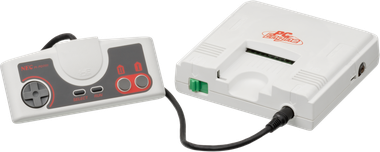
PC Engine / TurboGrafx-16 Specifications
- Processor
- Hudson Soft HuC6280 (8-bit, 65C02 based)
- Processor Speed
- 1.79 MHz or 7.16 MHz
- RAM
- 8 KB
- GPU
- Hudson Soft HuC6270 video display controller and HuC6260 colour encoder
- Video RAM
- 64 KB
- Resolution
- 256 x 224 up to 512 x 242 pixels
- Media
- HuCard, CD-ROM with the CD-ROM² add-on
Overview
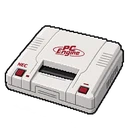
The PC Engine is a home console developed by NEC and Hudson Soft. It was released in Japan in October 1987 and reached North America in 1989 as the TurboGrafx-16, in a larger black case.
Its main processor is an 8-bit Hudson Soft HuC6280, but it is paired with a 16-bit graphics chip, which is why NEC marketed it as a 16-bit system. Games came on HuCards, thin credit card sized cartridges.
In 1988 NEC released the CD-ROM² add-on, which made the PC Engine the first console with a CD-ROM drive. Later System Cards and the Super CD-ROM² and Arcade CD-ROM² formats added more memory. Several models followed, including the SuperGrafx with a second video chip, the handheld PC Engine GT (TurboExpress) and the combined PC Engine Duo.
The PC Engine was very successful in Japan, where it outsold the Famicom for a time and competed strongly with the Super Famicom, but the TurboGrafx-16 struggled against the Genesis and SNES in North America. Its library is known for shoot ’em ups such as Gate of Thunder and Soldier Blade, and for games like Bonk’s Adventure and Ys Book I & II.
For accurate PC Engine, SuperGrafx and CD-ROM² emulation today, Geargrafx and Mednafen are the strongest choices. ares and Mesen also emulate the PC Engine as part of their multi-system cores.
Key Features
Tiny HuCards
Games came on thin, credit card sized HuCards.
First CD-ROM Drive
The CD-ROM² add-on made it the first console with CD-ROM.
16-Bit Graphics
An 8-bit HuC6280 paired with a 16-bit graphics chip.
Many Models
Variants included the SuperGrafx, handheld GT and the Duo.