Amiga
Commodore's 16-bit multimedia computer
- 1985Released
- Home ComputerType
- CommodoreDeveloper
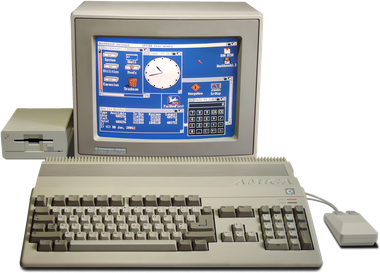
Amiga 500 Specifications
- Processor
- Motorola 68000 (16/32-bit)
- Processor Speed
- 7.16 MHz (NTSC) | 7.09 MHz (PAL)
- RAM
- 512 KB chip RAM, expandable
- GPU
- Original Chip Set (OCS): Agnus, Denise and Paula
- Resolution
- 320 x 256 up to 640 x 512 pixels (PAL), 32 colours from 4,096
- Media
- 3.5 inch floppy disk (880 KB)
Overview
The Amiga is a family of personal computers sold by Commodore. The first model, the Amiga 1000, was released in July 1985. It was designed by a team at Amiga Corporation, which Commodore bought in 1984.
All Amigas use Motorola 68000 series processors together with custom chips for graphics, sound and memory access. This let the Amiga show more colours, move graphics faster and play four channels of sampled sound at a time when most home computers could not. It also had a pre-emptive multitasking operating system, AmigaOS.
The Amiga 500 of 1987 was the most successful model. It was very popular in Europe, especially the United Kingdom and Germany, and became a leading games machine of the late 1980s and early 1990s. The Amiga was also used for video production through the Video Toaster, and for music, where its tracker software shaped a whole genre of electronic music.
Later models such as the Amiga 1200 and Amiga 4000 added the AGA chipset, and Commodore also released the CD32 console. Commodore went bankrupt in 1994, which ended the original Amiga line, although the platform still has an active community.
WinUAE is the most accurate and complete Amiga emulator and runs on Windows. Amiberry, which is built on the WinUAE core, is the best choice on Linux, macOS, Android and the Raspberry Pi.
Key Features
Custom Chipset
Custom chips handled graphics, sound and memory access.
Sampled Sound
Four channels of sampled sound, shaping tracker music.
Multitasking OS
AmigaOS brought pre-emptive multitasking to home computers.
Video Production
Used for video production through the Video Toaster.